The Earth breathes! Every year, biology harvests about 1/7 of all the CO2 in the atmosphere and converts it to living protoplasm, and each year biology also creates 1/7 of all the CO2 in the air through respiration and decomposition of organic matter.

Carbon and oxygen are among the most abundant elements in the universe because they are the very next elements formed after helium by nuclear fusion during the lives of stars. Like the rest of the universe, the Earth is rich in these elements, but for the most part they are tied up in more complex compounds.

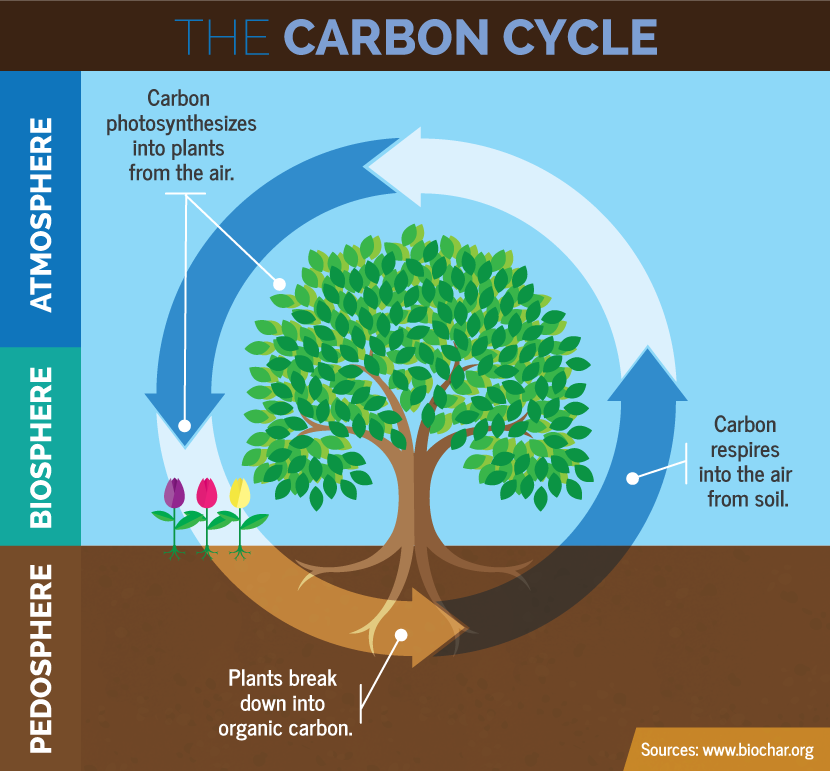
The living biosphere uses solar energy to separate these key elements and form a planetary-scale electrical circuit, working precisely as a gigantic battery. Oxygen is separated form water and pumped out into the air. Carbon is gathered from the air and reduced to form complex organic molecules by combining it with the hydrogen from water. The separation of oxygen and carbon stores energy that is later released by respiration, and its this downhill flow of energy that drives all metabolic processes on Earth.  Our bodies are part of the lungs of our planet. We sustain our bodies with high-energy compounds ingested through our mouths. We breathe free oxygen from the air and dissolve it into specialized molecules in our blood. We transport both the carbon compounds and the free oxygen throughout our bodies by pumping it through our hearts and arteries and veins. And then we react the carbon and oxygen in the mitochondria of every cell to drive the chemistry that makes us alive.

The steady inhalation and exhalation of life has continued unabated for billions of years on this planet. We have never found any evidence of these reactions anywhere else in the universe, yet we know that all the ingredients of our planetary breath are ubiquitous in the cosmos.
The late writer Arthur C. Clarke said “Two possibilities exist: either we are alone in the Universe or we are not. Both are equally terrifying.”