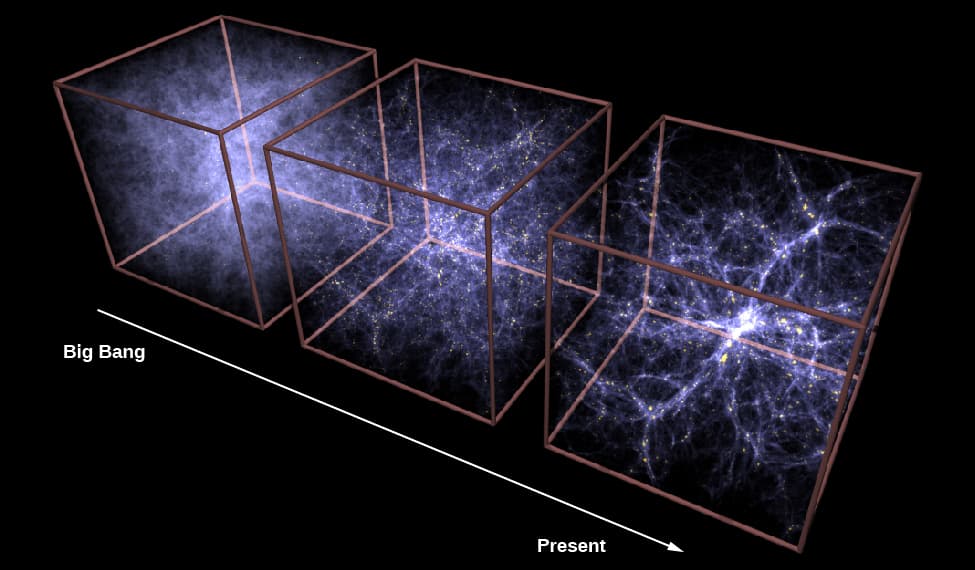
Galaxies are enormous structures held together by their own gravity and sometimes exhibiting amazing behavior associated with star formation and destruction. But there are even larger structures in which galaxies are embedded. Our galaxy is one of three large galaxies in a Local Group of a few dozen such structures, loosely bound by gravity and orbiting a common center.

Our Local Group is a perhaps 10 million light years across, and is part of a Local Supercluster of groups like it. The center of our Local Supercluster lies about 65 million light years away in the direction of the springtime constellation Virgo. Over the past 50 years, astronomers mapping clusters and superclusters of galaxies across the local universe have realized that the superclusters themselves are organized along filaments and sheets woven into a cosmic web with unimaginably huge voids in between the filaments.
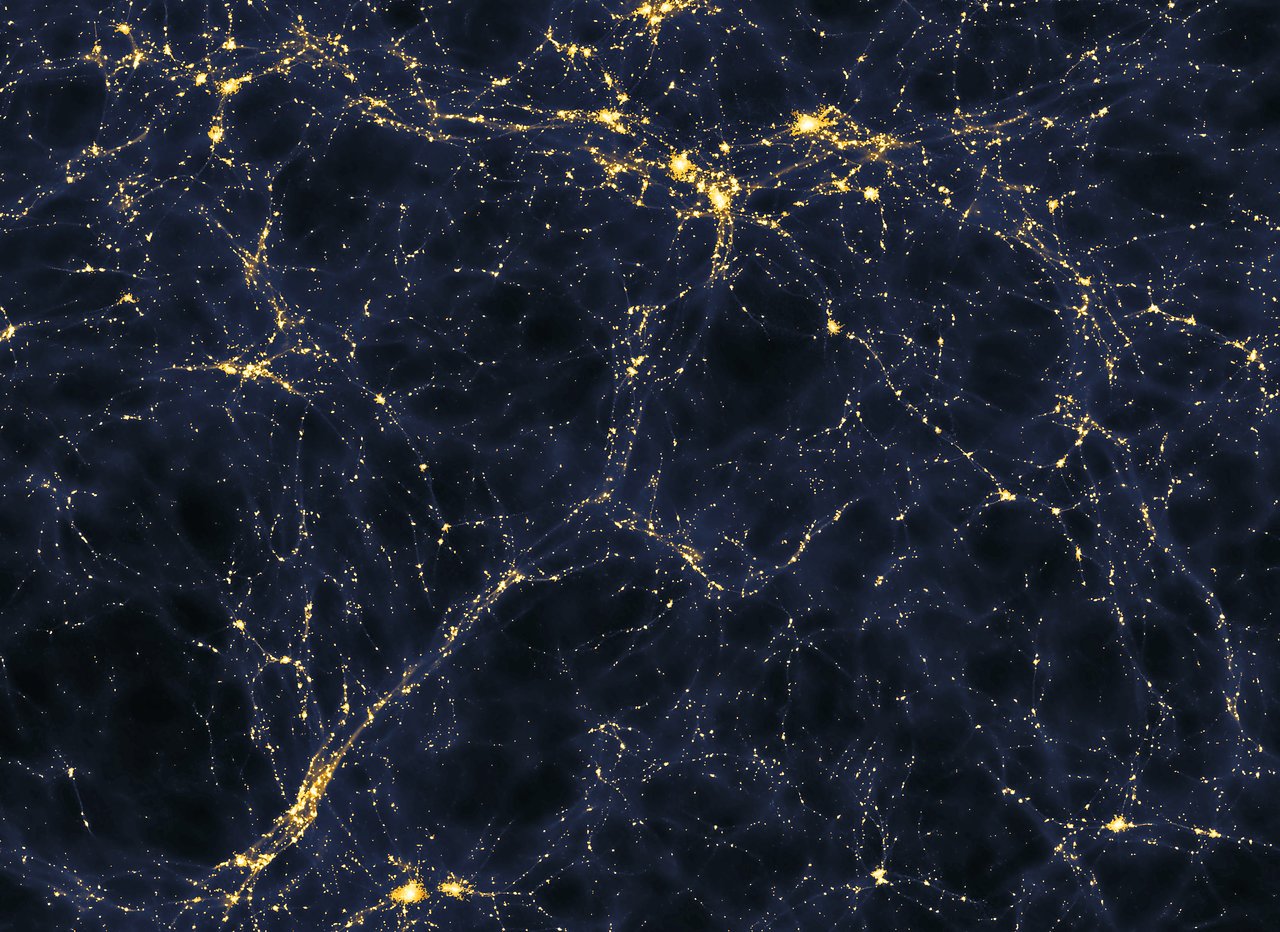
The cosmic web is sculpted by gravity. The filaments of galactic superclusters become finer and denser with time as they fall into themselves, whereas the voids become more empty because there’s no mass to hold them together. At the largest scales (hundreds of millions of light years, the 3D structure of the universe is like a sponge. The filaments and sheets are superclusters of galaxies containing each trillions of stars and planets, whereas the voids in the sponge are largely empty and devoid of matter.