
Star clusters and clouds of gas and dust are not distributed randomly in our galaxy but are instead organized in great spiral arms rotating like spokes around a spherical bulge in the center. We live in just such a spiral arm, about halfway out from the center of our Galaxy toward its rim.
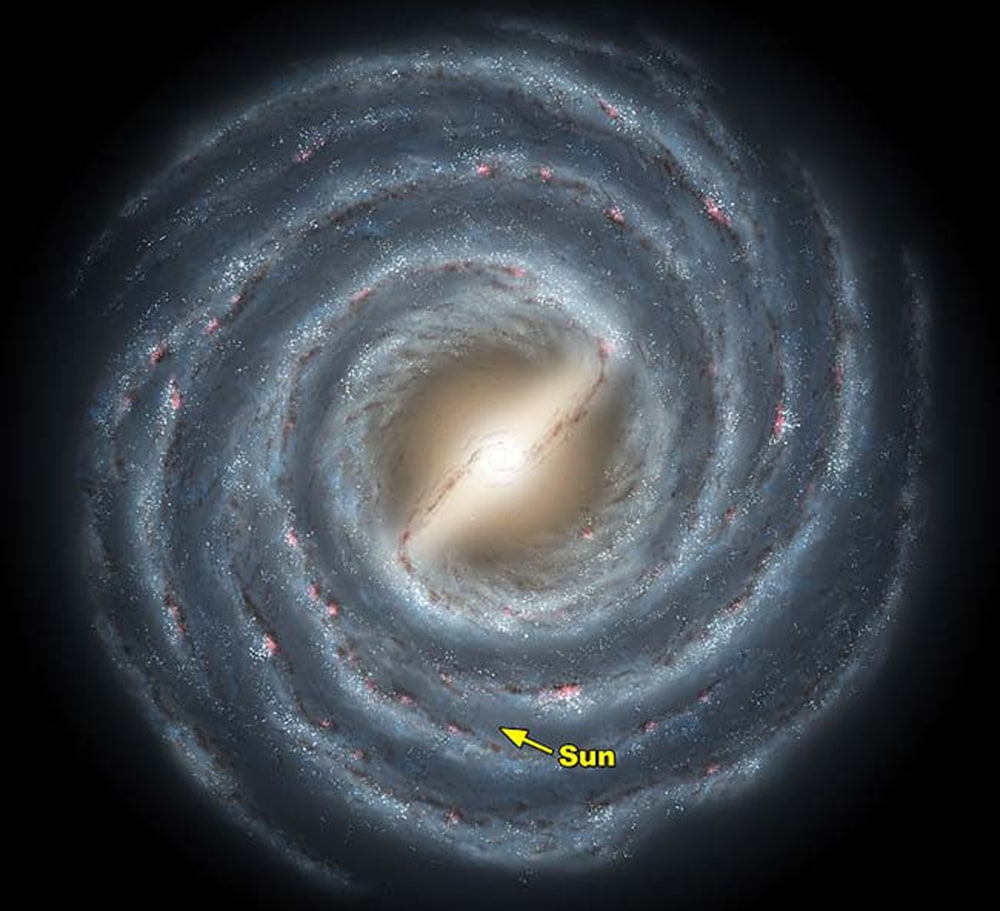
Everybody has seen pictures of spiral galaxies, but of course nobody has ever seen our own galaxy from the outside. Our galaxy is a huge disk about 100,000 light years across, but only about 3000 light years thick. The center of our galaxy lies 26,000 light years away in the direction of the constellation Sagittarius, low in the south on summer evenings. Conversely, the outer rim of our galaxy is in the direction of Orion and Gemini, high on winter evenings. When we look toward the Big Dipper, we are looking “straight up” out of the disk of our galaxy into the great beyond.
Contrary to most people’s imagination, spiral arms are not “wound up” by the rotation of a spiral galaxy, nor is there actually much more material in the arms than between them. Rather, the spiral arms are waves of star formation sweeping through the galactic disk. Almost all the stars formed in our galaxy form in these spiral waves. The spiral arms are not a thing so much as a phenomenon — not a noun so much as a verb!
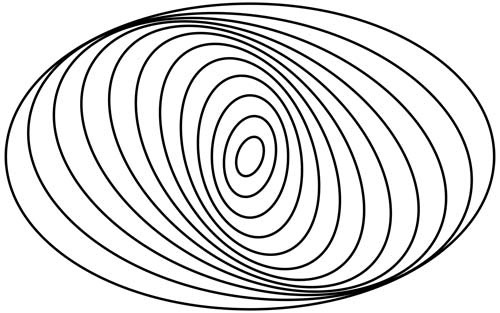
Spiral waves of density sweep through galactic disks, pushing interstellar gas and dust together along their leading edges. By mutual gravitation the atoms of gas and grains of dust swept together by a spiral density wave become more dense still, and some of it will collapse to form clusters of new stars. Each new cluster will contain some very large stars that burn blue and hot, which is why the spiral arms of galaxies stand out in such lovely relief against the dark of night. These same bright blue stars in new clusters emit copious amounts of UV radiation, causing the neighboring gas to fluoresce into deep red nebulae.
But spiral density waves march very slowly around a galactic disk, taking hundreds of millions of years to complete a circuit. Before they’ve progressed even a few degrees of galactic longitude, the newly formed blue giant stars created by the wave exhaust their hydrogen and explode into supernovas. The shock waves formed by these supernovas are believed to be part of the mechanism that propels the wave forward through the galactic disk.

The leading edge of a spiral wave of creation is therefore lit up with bright blue stars and red nebulae, while the trailing edge is littered with the debris of mineral dust and soot spewed out during the death throes of these behemoths. As the spiral waves crash through repeatedly over billions of years, they leave the galactic disk clogged with dark clouds of obscuring dust. We can see only dimly through these thick clouds along the plane of our own galaxy, but as we look perpendicular to the disk the skies are clear and our view extends for hundreds of millions of light years!
