
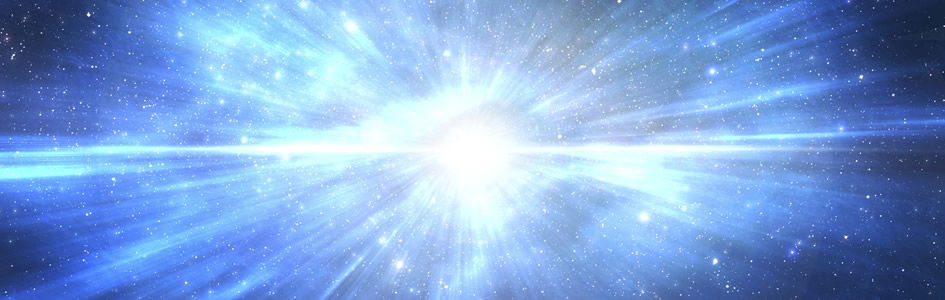
Time and space began in a flash of incandescence beyond imagination, so hot and bright that only radiance could exist. Inflating the cosmos, the radiance cooled enough that subatomic particles condensed from pure light. Thousands of years later, the plasma congealed into hydrogen atoms, releasing a fluorescent flash that remains today as the static between AM radio stations.

The primordial plasma was ever so slightly lumpy. The denser parts fell together under gravity, opening great voids in between what would become a cosmic web of matter that bends space and time around its knots and filaments. Lumps begat lumps begat ever smaller lumps until the densest lumps of hydrogen gas glowed hot under their own pressure. Insanely hot cores squeezed so tightly together that protons smashed into one another hard enough to overcome their like-charge repulsion and fused into helium through nuclear fusion. Thus were stars born millions of years after the first flash. The stars lit up the cosmic web as galaxies, spinning and merging and growing.

When stars consumed their hydrogen, their light began to fail and gravity once more crushed the mass together until the cores became hot enough to fuse helium, blowing their outer layers into the void as they became red giants. Helium cores fused into carbon, then oxygen. Bigger stars forged heavier elements like silicon, aluminum, and iron, then blasted these new ingredients out into space. This was the beginning of chemistry.

Waves of creative destruction swept through spiral galaxies, whisking up the dusty, smoky smithereens of stars to create new solar systems in their wakes. Carbon, nitrogen, oxygen, and the ubiquitous hydrogen formed organic compounds in empty space. Diamond dust condensed from supernova plasma along with a dozen other dusty ur-minerals. Clouds of soot and grease and dust and ice swirled around newborn suns as the spiral arms wheeled round and round.