

When stars die they spew their remains into space in an expanding cloud of charged particles that cools by dilution. As it cools, electrons are captured by atomic nuclei to form neutral atoms, and eventually some of these atoms become cool enough to condense into mineral crystals. This happens when the expanding cloud of plasma cools to a few thousand degrees. The mineral crystals that condense directly from interstellar plasma are called ur-minerals by Bob Hazen, and this mineral dust is made of a just a dozen or so ur-minerals.
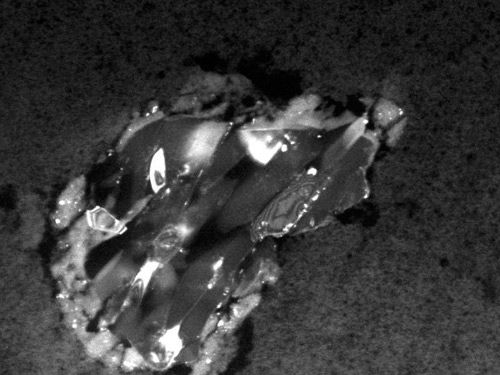
Among the first-formed ur-minerals that condense directly from the stellar plasma are crystals of pure carbon, which we know as diamond. Other ur-minerals condensed at thousands of degrees include spinel, silicon carbide, and graphite. These typically form within a year of a supernova explosion, and can persist essentially forever as specks of mineral dust floating among the stars. By the time an expanding cloud of supernova debris becomes cool enough to condense other minerals, it’s too dilute for them to form. Instead, atoms of heavy elements such as carbon, hydrogen, oxygen, and nitrogen float through interstellar space as extremely thin gases.
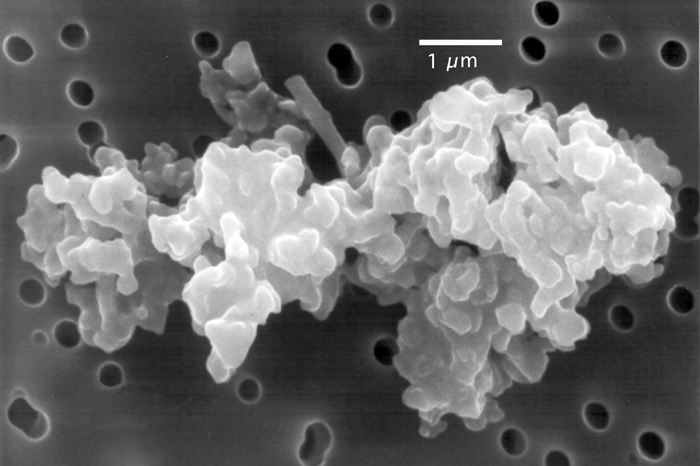
Occasionally atoms of gas in deep space collide with mineral dust and then stick, forming coatings of ice that can react in the extreme cold of space to form complex molecules. This material is very rich in carbon because it only takes three helium atoms to make a carbon in the active core of a star. Interstellar dust is therefore rich in carbon compounds, some of which can only exist at extremely low temperatures. Other gases and ices in interstellar dust clouds are familiar organic molecules: water, carbon monoxide, CO2, methane are abundant.

Organic chemistry in cosmic dust clouds is surprisingly active as well. Cosmic clouds are a lot like smoke: bits of soot and grease and hydrocarbons, even benzene and amino acids have been detected in cosmic quantities. These clouds of dust are dark, obscuring big swaths of our night sky and hiding the multitudinous stars behind curtains of carbon. They are also the building blocks of the next generation of stars and planets and people!